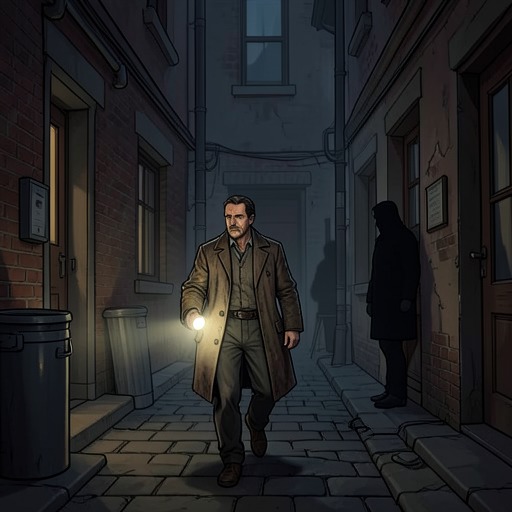
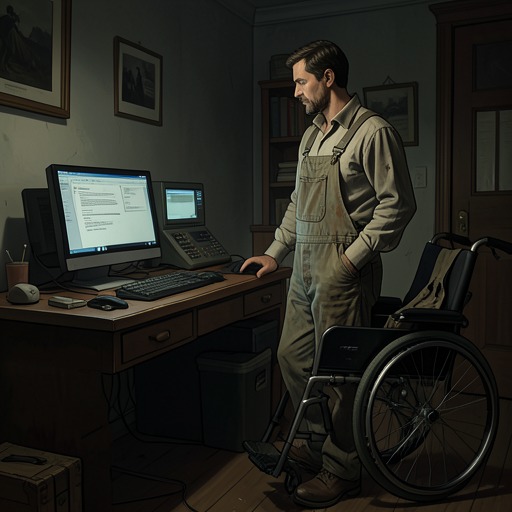
Before the main events
The Hay-Truck Epigraph
A brief literary epigraph opens the novel with the line, “[They threw me off the hay truck about noon](entity:expression-recall-expression-they-threw-me-off-4e325369f6d7),” invoking a story of sudden displacement and hardship. Its starkness foreshadows the people about to be thrown into crisis by a collapsing economy and a killer’s violence.
Late night, April 9, 2009
The Job-Fair Queue
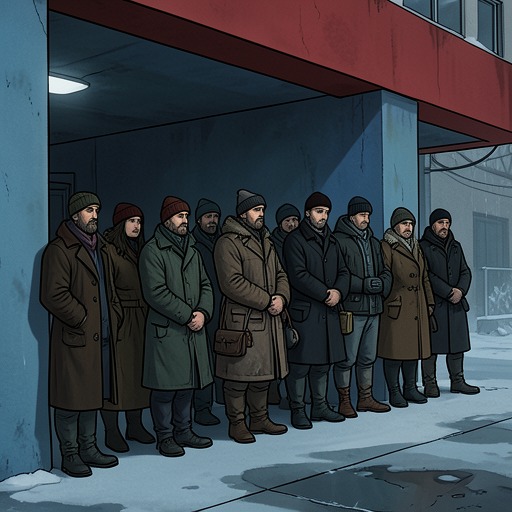
Unemployed former shipping clerk [August Odenkirk](entity:character-recall-character-august-odenkirk-3450ab51917b) arrives at [City Center](entity:location-recall-location-city-center-66d9282025b7) for the promised job fair and finds dozens already waiting. At the end of the line, he meets [Janice Cray](entity:character-recall-character-janice-cray-f1384340ecff), who has brought her sleeping infant daughter, Patti, because she has neither childcare nor money to pay for it.
After midnight, April 10, 2009
A Night of Small Kindnesses
As fog and damp chill thicken, Janice falls asleep on her feet and Patti wakes hungry and wet. August gives Janice his sleeping bag to warm herself and the baby, helps her change Patti, and shields them from hostile onlookers; in return, he begins to imagine a modest breakfast together after the job fair.
About 5:20 a.m., April 10, 2009
The Mercedes Attack
A gray Mercedes bursts through the fog and accelerates into the packed queue, crushing and trampling people trapped by the barricades. August throws himself over Janice and Patti as the car bears down; the attack kills eight people, including mother and child, and leaves others gravely injured.
About six months after the massacre
The Retired Detective’s Routine
Retired detective [K. William Hodges](entity:character-recall-character-k-william-hodges-8f63f4e8e583) spends his afternoons watching lurid television, drinking little, and handling his late father’s Victory .38. His retirement has left him isolated and purposeless, and he has begun testing the feel of the loaded revolver in his mouth while considering suicide.
Six months after the massacre
Bum Fighting on Television
A daytime confrontation show reminds Hodges of the late-eighties fad of staged homeless-person fights, which he once broke up with [Pete Huntley](entity:character-recall-character-pete-huntley-0e745c129013). To him, both spectacles turn human degradation into entertainment, with audiences encouraged to enjoy violence from a safe distance.
A weekday afternoon, six months after the massacre
The Killer’s Letter
A letter addressed to the retired detective arrives with a grinning sunglasses smiley. Its writer claims to be the Mercedes Killer, boasts of the massacre, and taunts Hodges about his retirement and suicidal thoughts, ending with an invitation to contact him through [Under Debbie’s Blue Umbrella](entity:expression-recall-expression-under-debbie-s-blu-4dcaf27f2d5c).
The afternoon Hodges reads the letter
A Killer Without Conscience
The correspondent describes the killings as thrilling, denies any conscience, and suggests that Hodges should use his gun to end his life. He also reveals details about the crime scene, including a hairnet and bleach, that were withheld from the press, persuading Hodges that the letter may be genuine.
That afternoon and evening
The Choice Not to Call
Hodges recognizes that turning the letter over to [Pete Huntley](entity:character-recall-character-pete-huntley-0e745c129013) would reactivate the case, but fears the killer wants the letter leaked and wants to push him toward suicide. He puts off contacting the police, researches the killer’s clues, and realizes the taunt has given his own stalled life a purpose.
The following morning
The Hidden Observer
The narrative shifts to [Brady Hartsfield](entity:character-recall-character-brady-hartsfield-36f511443376), who works at [Discount Electronix](entity:location-recall-location-discount-electronix-96945130e0d0) and listens to [Freddi Linklatter](entity:character-recall-character-freddi-linklatter-8397d2b478a4)’s break-time stories while wondering how Hodges received his letter. Brady has been watching Hodges from the street and knows about the revolver beside his chair, treating the former detective’s depression as an opening to exploit.
Spring 2010, after the letter
Brady’s Double Life
Brady works a second job driving the Mr. Tastey ice-cream truck, using his friendly public image to blend into neighborhoods while privately fantasizing about further mass violence. His thoughts reveal that the massacre was not a one-off thrill: he is still considering bombs, poison, and attacks on crowds.
Spring 2010
A Mother’s Manipulation
At home, Brady’s mother [Deborah Ann](entity:character-recall-character-deborah-ann-d71f75444ecb) flirts with him in ways that leave him aroused and ashamed. Their distorted intimacy, her alcoholism, and Brady’s resentment help expose the damaged private world he hides behind his public jobs.
The day after the letter
Hodges Reopens the Case
Hodges studies the crime coverage and calls [Pete Huntley](entity:character-recall-character-pete-huntley-0e745c129013), asking him to lunch under the pretense of catching up. He learns that the Mercedes case remains unsolved and hears that Pete’s new partner, [Isabelle Jaynes](entity:character-recall-character-isabelle-jaynes-3c0b254d356b), is still canvassing the Trelawney neighborhood.
The day after the letter
The Job-Fair Investigation Revisited
Over lunch at DeMasio’s Italian Ristorante, Pete updates Hodges on several open cases, including the Mercedes killings. The conversation stirs Hodges’s doubts about the way the detectives treated [Olivia Trelawney](entity:character-recall-character-olivia-trelawney-ba8054d750ed), whose car was stolen and whose suicide followed the public blame directed at her.
During the original investigation, recalled the day after the letter
The Lost Key Question
Hodges recalls how Olivia insisted she removed and locked her Mercedes key, while investigators believed she had left it in the ignition. The detectives’ dislike of her manner made it easier to accept a theory that assigned her blame for the killer’s access to the car.
About an hour after the attack, April 10, 2009
The Original Crime Scene
Police find the battered Mercedes behind a warehouse, its windshield and front end spattered with blood. Hodges spots a wedding ring caught in the grille, and the detectives discover a clown mask on the driver’s seat and evidence that the air bags were disabled.
Morning of April 10, 2009
Olivia’s First Interview
Hodges and Pete interview Olivia at her mother’s condominium. She says she parked near the building, carried food upstairs, and put her key away; when pressed, she insists she locked the car, then claims she has never owned a spare key.
Later on April 10, 2009
The Spare-Key Assumption
A Mercedes mechanic confirms that the car was not hotwired or visibly forced open and says it must have been left with a key available. Learning that two keys came with the vehicle, Hodges and Pete conclude that Olivia left one in the ignition and gave them the spare, never testing another possibility.
Several months after the massacre, 2009
Olivia’s Suicide
Olivia takes her mother’s pain medication and dies by suicide after the massacre’s public scrutiny, police questioning, and shame have deepened her existing anxiety and compulsive behavior. At the time, Hodges and Pete read her death as confirmation that she knew she had left the key in the car.
The evening after the letter arrives
The Blue Umbrella Search
Hodges searches for the site Brady named but hesitates to register, aware that the service could expose his computer and private life. He instead calls [Jerome Robinson](entity:character-recall-character-jerome-robinson-568d679de15b), asks him to come over, and begins to consider whether the site is a channel for conversation or surveillance.
The next afternoon
Jerome’s Caution
Jerome explains that anonymous chat sites can conceal malicious activity and advises Hodges not to use his own computer. Their conversation establishes Jerome’s technical skill and Hodges’s growing trust in him, while underscoring the risk of letting the killer into a digital life.
The following day
The Second Letter
Hodges visits Olivia’s sister, [Janelle Patterson](entity:character-recall-character-janelle-patterson-2f06c8075e12), and learns she has found a second letter from the killer among Olivia’s papers. The letter pretends remorse, blames Olivia for leaving her key, and invites her to communicate with him online, while threatening suicide if she hands it to police.
During Hodges’s first meeting with Janelle
The False Remorse
The letter’s writer claims an abusive childhood, a sick alcoholic mother, and a life of loneliness, then says Olivia is the only person who can keep him alive. Hodges recognizes the suicide threat as coercion and sees that the supposed confession is designed to make Olivia feel responsible for the killer.
The same meeting
Janelle Hires Hodges
Janelle says her mother remembers Olivia communicating with a disturbed man beneath the Blue Umbrella. She hires Hodges to investigate Olivia’s death, and he accepts, discounting the legal risk of withholding the letters because he wants to pursue the killer himself.
During the first meeting, in recollection
Olivia’s Troubled History
Janelle describes Olivia as bright and beautiful but chronically anxious, compulsive, and easily overwhelmed. After marrying Kent Trelawney, Olivia improved with medication; after his death, many old symptoms returned, making her especially vulnerable to the killer’s pressure.
During Hodges’s visit to Sunny Acres
The Computer Pen-Pal
[Elizabeth Wharton](entity:character-recall-character-elizabeth-wharton-12c4f7fcf022), briefly lucid, tells Hodges that Olivia’s online correspondent called himself Frankie and persuaded her to stop taking medication. He also urged her to believe that the same drugs had made him commit the massacre, turning her attempt to save him into a path toward her own collapse.
At the end of the Sunny Acres interview
The Ghosts at Home
Elizabeth says Olivia heard the murdered baby, Patricia, crying in the house and imagined Janice accusing her of allowing the murder. She identifies the emotional burden that finally overwhelmed Olivia, transforming the supposed haunting into a vivid expression of guilt and trauma.
After the nursing-home visit
The First Break in the Key Case
On a walk with Jerome, Hodges presents a fictionalized version of the Mercedes mystery. Jerome recalls that his own mother once had a spare key hidden in a glove compartment without knowing it, giving Hodges a plausible explanation for the key Olivia denied possessing.
That evening
The Blue Umbrella’s Privacy
Jerome investigates the chat service and reports that it uses encrypted overseas servers, prevents ordinary printing, and allows a user’s subscription to be paid in advance. Since Brady has already supplied Hodges a username, the killer can be waiting for him when he enters.
Early the next morning
The Withheld-Evidence Bluff
Hodges creates a deliberately provocative message claiming that withheld evidence proves the writer is not the Mercedes Killer. The bluff exploits the killer’s need for recognition and credibility, and Brady reads it as an insult to the authorship of his massacre.
The same night
Brady’s Anger Surfaces
Brady reacts to the message with fury and tears, then decides to punish Hodges through Jerome’s family dog, [Odell](entity:character-recall-character-odell-bcb61cb3301a). He orders strychnine poison and imagines grief cascading from the dog to Jerome and finally to Hodges.
The following weekend
The Poisoned Hamburger
Brady prepares a hamburger laced with [Gopher-Go](entity:object-recall-object-gopher-go-2d9843ab0639), intending to feed it to [Odell](entity:character-recall-character-odell-bcb61cb3301a) when the dog is tied outside Zoney’s GoMart. He abandons the plan only in the sense that he intends to accept the consequences, still focused on hurting Hodges through Jerome.
Sunday afternoon
Brady’s Mother Eats the Bait
[Deborah Ann](entity:character-recall-character-deborah-ann-d71f75444ecb) finds the poisoned meat in Brady’s garage refrigerator, cooks some of it, and suffers violent strychnine convulsions in the living room. Brady refuses to call emergency services because he fears the scrutiny, leaving his mother to die.
Later that Sunday
A Death Hidden Upstairs
Brady drags his mother’s body to her bedroom and covers her with a bedspread, then retreats to his basement control room. He blames Hodges for the death and sends him a threat through the Blue Umbrella, escalating the contest from provocation to explicit violence.
The following Wednesday, June 2, 2010
The Bomb in Hodges’s Car
At [Elizabeth Wharton](entity:character-recall-character-elizabeth-wharton-12c4f7fcf022)’s memorial service, Brady uses [Thing Two](entity:object-recall-object-thing-two-a4a0ae9f5519) to unlock [Hodges’s Toyota](entity:object-recall-object-hodges-3d5d310c6349) and plants a concealed bomb behind the driver’s seat. He intends to detonate it after Hodges leaves, believing Janelle will be in the car with him.
Immediately after the memorial service, June 2, 2010
The Wrong Driver
Janelle takes Hodges’s car keys at the last moment so he can ride with her relatives, leaving her to drive the Toyota alone. Brady remotely detonates the device as the car pulls away, killing Janelle and destroying the vehicle while Hodges survives.
Minutes after the explosion
The Pursuit Becomes Personal
Hodges runs toward the wreck and sees the devastation, including Janelle’s severed arm. He suppresses his shock long enough to contact Jerome, conceal what the police do not yet know, and begin pursuing the killer outside official channels.
That evening
Brady’s False Victory
Brady returns home believing he has killed Hodges, only to find his mother dead and the house beginning to smell. He tells himself the plan succeeded, but the loss and the knowledge that Hodges may have survived unsettle him.
Late June 2, 2010
The Bombing Confession Online
Hodges, communicating through Jerome, tells Brady he survived and claims to know about the car break-ins, the stolen key signal, and the killer’s repeated mistakes. He threatens to kill Brady himself, reversing the killer’s earlier power over the retired detective.
June 3, 2010, afternoon
The Arms Raid
A routine police encounter near [King Virtue Pawn & Loan](entity:location-recall-location-king-virtue-pawn-loa-ee52977d0b77) exposes a massive stockpile of weapons and explosives. [Pete Huntley](entity:character-recall-character-pete-huntley-0e745c129013) and the federal authorities converge on the arms operation, diverting much of the police force from Hodges’s pursuit.
June 3, 2010, afternoon
The Killer’s Computer Trail
Hodges searches the Hartsfield home and finds Deborah’s body, [Brady’s basement computer system](entity:object-recall-object-9cf787579594), and signs that the killer has left with his explosives. Jerome and Holly help examine the machines, while Hodges weighs whether to report everything to the police or continue on his own.
June 3, 2010, afternoon
The Widow’s Computer Ghosts
At Olivia’s computer, Jerome and Holly discover a hidden sound program that plays a crying baby and a woman accusing Olivia of letting her child be murdered. Holly also finds a remote-access tool, revealing that someone had been monitoring Olivia’s computer and could manipulate its contents after death.
June 3, 2010, late afternoon
The Killer’s Real Workplace
Hodges and Jerome trace the computer service to [Cyber Patrol](entity:organization-recall-organization-cyber-patrol-7634d3d2e648), a [Discount Electronix](entity:location-recall-location-discount-electronix-96945130e0d0) operation, and identify [Brady Hartsfield](entity:character-recall-character-brady-hartsfield-36f511443376) among its technicians. Jerome recognizes him as the Mr. Tastey ice-cream man who has repeatedly appeared in Hodges’s neighborhood and around the Robinson family.
Recalled in the hours before the concert
The Hartsfield Childhood
Brady’s memories reveal that his younger brother Frankie suffered severe brain damage after choking on an apple slice. Their mother’s neglect and resentment culminated in Brady deliberately kicking Frankie down basement stairs, after which she helped him stage the death as an accident.
After Frankie’s fall, years before 2009
A Mother’s Cover Story
Deborah tells Brady to repeat a false account of Frankie’s fatal fall and warns him never to add or change details. The shared lie binds mother and son, while Brady’s memories transform the murder into the foundation of his self-image as the household’s man of the house.
Spring 2010, before June 3
The First Grand Plan
Brady develops a bomb vest and imagines a spectacular mass attack, while maintaining a separate plan to provoke Hodges into suicide. He has already demonstrated his capacity for gadgetry with [Thing One](entity:object-recall-object-thing-one-d25f1a1b2de3), which can manipulate traffic signals, and [Thing Two](entity:object-recall-object-thing-two-a4a0ae9f5519), which captures car-entry codes.
June 3, 2010, morning
The Missing Key Is Explained
Jerome explains that a thief can capture and reuse the radio signal from a passive keyless-entry fob, a method called stealing the peek. Hodges realizes Brady could have unlocked Olivia’s car electronically, then found her unrecognized spare key inside the glove compartment.
June 3, 2010, morning
The Cars Were Watched
Hodges learns that a run of downtown car break-ins occurred between 2007 and 2009, ending shortly before the massacre. He recognizes them as Brady’s practice and backtrail, establishing that the killer had been refining the technology and stalking potential targets for years.
June 3, 2010, morning
Hodges’s Death Threat
Hodges claims that [Donald Davis](entity:character-recall-character-donald-davis-a038563ac6ee) is about to confess to the [City Center](entity:location-recall-location-city-center-66d9282025b7) massacre, then invents a hidden valet key to bait Brady into correcting him. Brady responds in furious, error-filled messages and insists Davis did not commit the crime, supplying details only the real killer would know.
June 3, 2010, morning
Davis Confesses
Pete reports that [Donald Davis](entity:character-recall-character-donald-davis-a038563ac6ee) has confessed to murdering his wife and claims to be Turnpike Joe, a serial rapist and killer. Hodges urges Pete to protect Davis’s rights and obtain counsel, then recognizes that the confession gives him a useful way to provoke Brady.
June 3, 2010, late morning
A Second Attack Is Planned
Brady reads Hodges’s taunt and fears that Davis will claim the [City Center](entity:location-recall-location-city-center-66d9282025b7) murders as well. He buys more poison and imagines killing [Odell](entity:character-recall-character-odell-bcb61cb3301a) and the Robinson family, but then shifts his attention toward an even larger public spectacle at the [Midwest Culture and Arts Complex](entity:location-recall-location-midwest-culture-and-0ab386c5efc1).
June 3, 2010, afternoon
The Concert Reconnaissance
Brady surveys the MAC, studies its entrances and security, and notices the no-bags policy and lack of visible metal detectors. He considers carrying his explosives inside a wheelchair, but doubts whether he can conceal the device well enough to reach the auditorium.
June 3, 2010, late afternoon
The Career-Day Target
Hodges and his companions find an upcoming job fair at Embassy Suites advertised for Saturday morning. Because the planned attack echoes Brady’s first massacre, they conclude that he intends to target job seekers again, and Hodges warns [MAC Security](entity:organization-recall-organization-mac-security-d0d47286eac5) about Brady as a possible child predator to prompt a watch without revealing the bomb threat.
June 3, 2010, late afternoon
The Concert Ticket
A closer inspection of Brady’s computer reveals that he has purchased a ticket for the sold-out ’Round Here concert that evening. The discovery overturns Hodges’s belief that the job fair is the immediate target and sends him, Jerome, and Holly racing toward the MAC.
June 3, 2010, before 6:00 p.m.
The Wheelchair Bomb
Brady converts a wheelchair into a rolling bomb, packing it with homemade plastic explosive and ball bearings and wiring it to [Thing Two](entity:object-recall-object-thing-two-a4a0ae9f5519). He disguises himself as a bald, sickly concertgoer, carries a picture of Frankie, and plans to detonate the device amid thousands of young fans.
June 3, 2010, shortly after 6:00 p.m.
The Friends Enter the Basement
Hodges, Jerome, and Holly return to the Hartsfield house and use Brady’s mother’s computer to uncover his secret notes. Holly recognizes the voice-command pattern: control turns on the lights, chaos starts the computers, and darkness stops their data-erasure countdown.
June 3, 2010, about 6:45 p.m.
The False Lead Breaks
The trio discovers Brady’s concert ticket and realizes the concert, not the job fair, is the immediate danger. Hodges tries to reach security while Jerome drives the Mercedes toward the MAC, but jammed phone lines and automated menus delay the warning.
June 3, 2010, shortly after 7:00 p.m.
A Dangerous Entrance
The concert begins before Hodges can reach the proper security staff. He, Jerome, and Holly enter through the loading area and learn that Brady is already inside among the wheelchair section, where he can trigger the bomb near the packed audience.
June 3, 2010, during the opening songs
The Trap in the Auditorium
Hodges concludes that the bomber has disguised himself as harmless and placed himself in the handicapped section. His heart begins to fail under the strain, so he sends Jerome and Holly ahead while he stays behind to manage the emergency and avoid provoking Brady into detonating the device.
June 3, 2010, during the concert
Holly Faces the Killer
Holly approaches Brady and calls him Mike Sturdevant, the high-school bully whose cruelty helped precipitate her first breakdown. The name startles him, and Holly strikes his head twice with Hodges’s [Happy Slapper](entity:object-recall-object-happy-slapper-d8b0e5163892), knocking him unconscious before he can press the detonator.
Moments after Brady is struck
The Bomb Is Disarmed
Jerome restrains Brady’s hands while Holly examines [Thing Two](entity:object-recall-object-thing-two-a4a0ae9f5519) and removes one of its batteries. The ready light goes out, disabling the detonator; the audience continues cheering, unaware that Holly and Jerome have prevented a mass killing.
Immediately after the bomb is disabled
The Family Escapes
Jerome warns his mother, Tanya, to take Barbara and the other girls out of the auditorium. Tanya obeys without demanding an explanation, while Holly keeps the nearby wheelchair user from touching Brady or the bomb until the device can be safely handled.
June 3, 2010, during the concert’s climax
Hodges Collapses
As music and cheering continue above, Hodges suffers a heart attack in the backstage storage area. A roadie attempts CPR while Hodges clings to the sounds from the auditorium, waiting to learn whether the explosion has been prevented.
After the concert, June 3, 2010
Brady’s Arrest and Coma
Police take Brady into custody, but Holly’s blows leave him in a deep coma with minimal brain function. Hodges awakens in intensive care and learns that Jerome and Holly have answered police questions and that no one in the audience was killed by the bomb.
After the concert, June 2010
The City’s Proclamation
The mayor awards Jerome and Holly the city’s Medal of Service for confronting Brady and preventing a catastrophe. Hodges receives no award, having been rebuked for his reckless, unofficial investigation, though he accepts that the two younger partners saved the crowd.
Summer and autumn 2010
The Investigation’s Aftermath
Hodges faces an official reprimand and the collapse of his hope for a licensed private-investigation career, but secures part-time work as a skip-tracer. He loses weight, receives a pacemaker, and remains haunted by Janelle’s death and his own role in the chain of events.
By late October 2010
Holly’s New Independence
Holly moves into the city with financial support from Janelle’s will and begins building a life less controlled by her mother. Jerome and Hodges remain close to her, and her friendships with the Robinson family become part of her gradual recovery.
Late October 2010
The Blue Mercedes
Holly has Olivia’s recovered Mercedes repainted baby blue and begins driving it without the same terror it once carried. She says the ghosts were present at first, but the new color has helped her associate the car with forgetting rather than the massacre.
November 2011
Hartsfield Awakens
After seventeen months in a traumatic brain injury clinic, Brady wakes and speaks to a nurse. His first complaints are a headache and a request for his mother, suggesting that his consciousness has returned to the same damaged dependencies that shaped his life before the attacks.